01 Work / Case Study

SAIT Mate

SAIT Mate

SAIT Mate

SAITMate: Bridging the Gap Between Students & Alumni
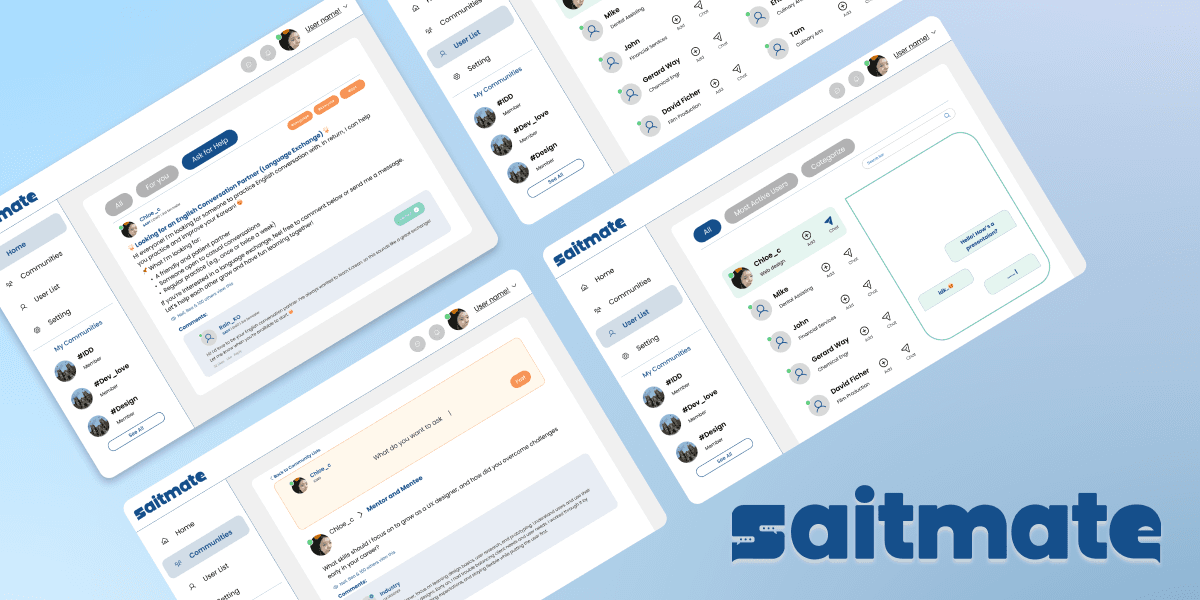
Project Overview

SAITMate is a platform designed to enhance communication and networking between students and alumni, addressing common challenges such as:

✶ Ineffective communication channels causing delays in student activities.

✶ Lack of mid-term mentorship, especially for specialized subjects.

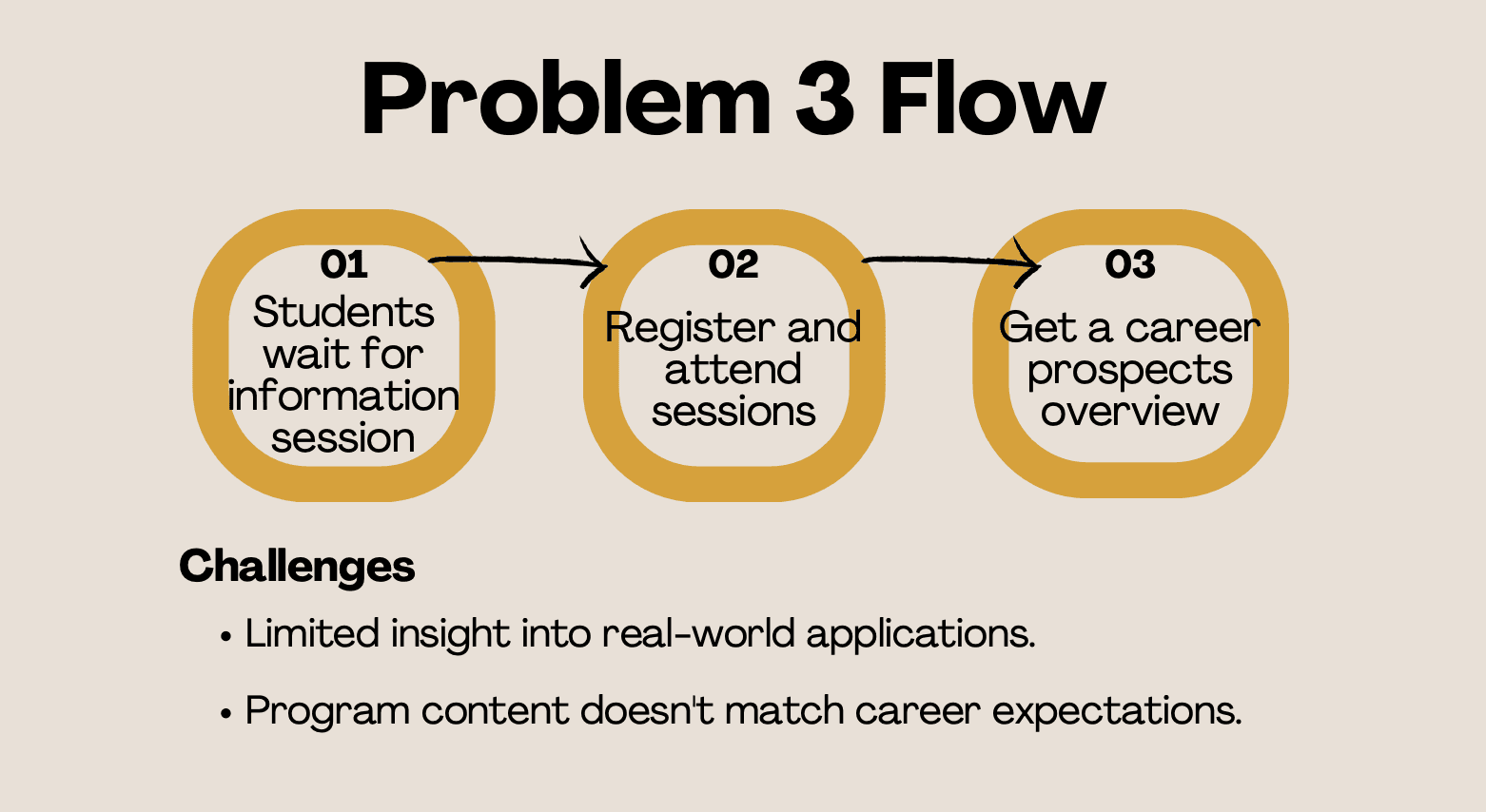
✶ Mismatch between student expectations and career pathways within their programs.

By fostering collaboration across programs, SAITMate helps students build connections, share ideas, and prepare for their careers more effectively.

  1. Identifying and Framing Problems

Origin of the  Idea: SAIT students find it hard to connect across majors because current communication channels don’t work well. This reduces chances for networking and sharing ideas.


Key Problems Identified:

  • SAIT students seeking mentors.

  • IDD students struggling with current courses.

  • IDD students unsure about choosing the right major.


Rationale: These challenges impact many students, affecting communication, collaboration, mentorship, and information sharing. By addressing these core issues, we aim to enhance learning and create stronger connections at SAIT, driving meaningful change.

  1. Generating Potential Solutions

Key Problems Identified:

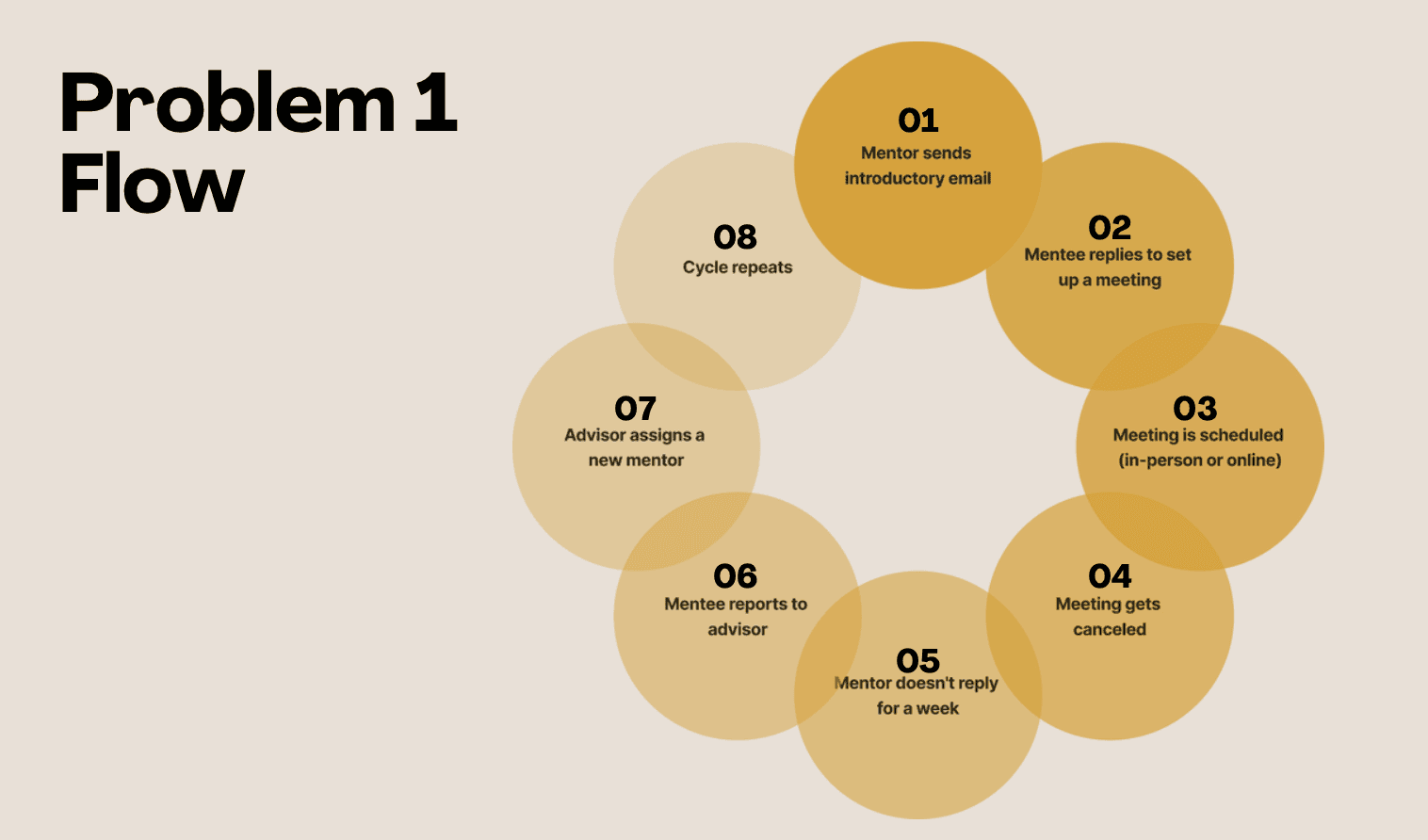
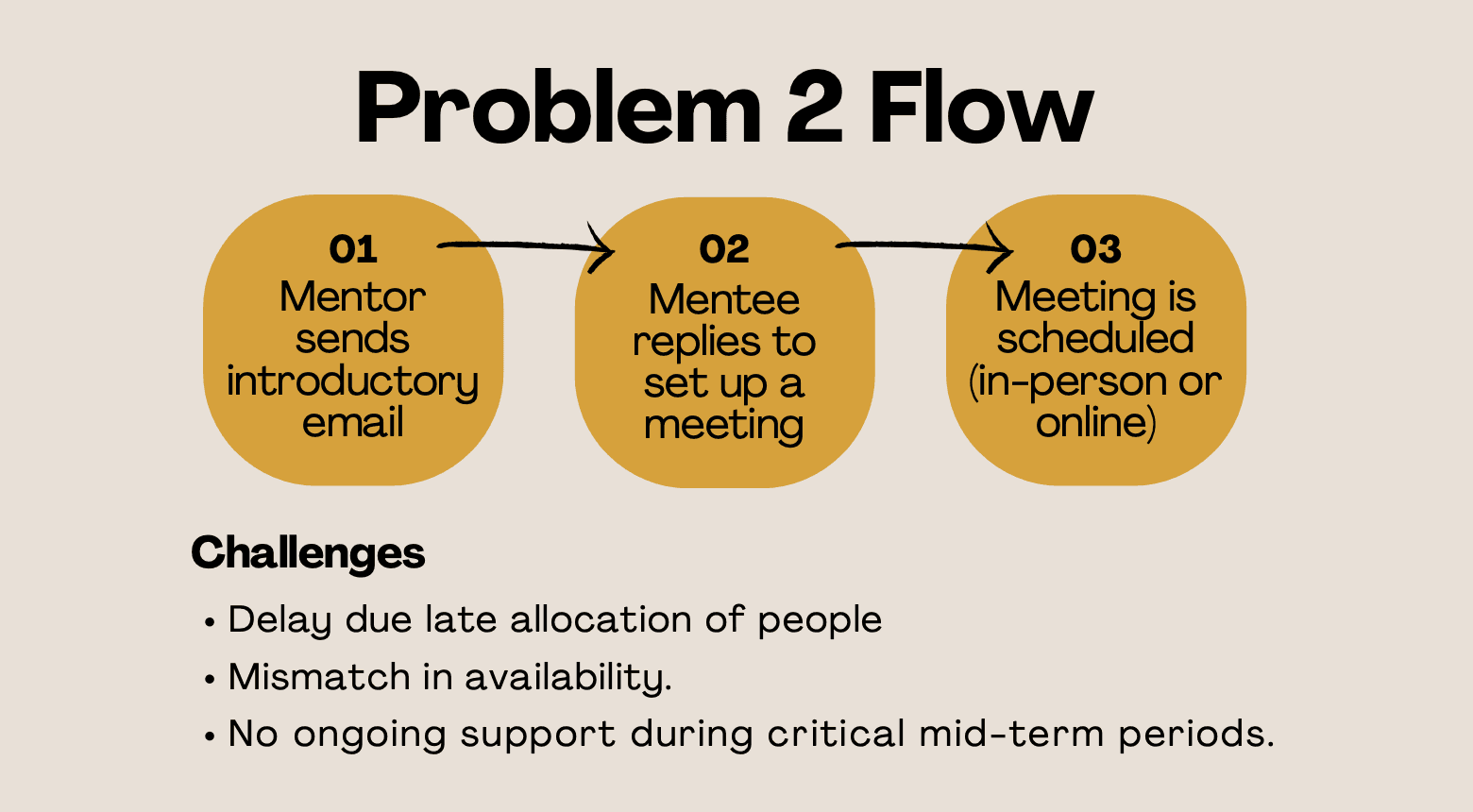
1️⃣ Ineffective Communication – Poor communication channels create delays, limiting student activities and learning opportunities.

2️⃣ Lack of Mid-Term Mentorship – Students struggle to find guidance, especially when facing challenges in specialized subjects.

3️⃣ Career Path Uncertainty – A gap exists between student expectations and the available career paths in the program, making it difficult to make informed decisions.
✸ Solution Overview

To create a website application that provides immediate connectivity and information sharing among SAIT students.

  1. Collecting Feedback

Research Methodology

Purpose of the Research

This survey aims to understand the current state of student collaboration across different schools and programs at SAIT, identify challenges, and explore potential solutions to improve cross-program collaboration.

Link to Survey

Target Audience & Sample Size

  • Surveyed 22 full-time students from various programs and year levels.

  • Respondents’ age groups:

    • 66% (25-34 years old)

    • 22% (18-24 years old)

    • Remaining: 35+ years old

  • Data collected through direct messaging, group pages, and club Discord servers.


Limitations

  • 99% of respondents were from the School for Advanced Digital Technology (SADT).

  • Most had little to no prior experience with cross-program collaboration. 


✸ Survey Sections & Key Findings

1. Challenges Identified

  • Limited Exposure: Over 50% had never collaborated with other programs.

  • Lack of Awareness: 77% didn’t know how to find students from other programs.

  • Communication Barriers: 40-60% felt unsure about reaching out or feared being ignored.

  • Scheduling Conflicts: 40%+ struggled to align availability with students from different programs.

  • Lack of Institutional Support: 27% wanted a centralized announcement board to find collaboration opportunities.

2. Opportunities Identified

  • Students want more collaboration opportunities but need a structured way to connect.

  • 73% believe a dedicated platform would help facilitate networking and project collaboration.

  • 55% would actively use a platform for finding parters; 40% would use it occasionally.

  • Microsoft Teams is widely used (86%), but students also prefer Discord for informal collaboration.


3. Potential Solutions

  • A SAIT-wide collaboration platform featuring:

    • Community Tab – A space to network and share ideas.

    • Partner Tab – A tool to match students based on skills and interests.

    • Announcement Board – A centralized place for faculty and students to post collaboration opportunities.

Research Methodology

Purpose of the Research

This survey aims to understand the current state of student collaboration across different schools and programs at SAIT, identify challenges, and explore potential solutions to improve cross-program collaboration.

Link to Survey

Target Audience & Sample Size

  • Surveyed 22 full-time students from various programs and year levels.

  • Respondents’ age groups:

    • 66% (25-34 years old)

    • 22% (18-24 years old)

    • Remaining: 35+ years old

  • Data collected through direct messaging, group pages, and club Discord servers.


Limitations

  • 99% of respondents were from the School for Advanced Digital Technology (SADT).

  • Most had little to no prior experience with cross-program collaboration.


✸ Survey Sections & Key Findings

1. Challenges Identified

  • Limited Exposure: Over 50% had never collaborated with other programs.

  • Lack of Awareness: 77% didn’t know how to find students from other programs.

  • Communication Barriers: 40-60% felt unsure about reaching out or feared being ignored.

  • Scheduling Conflicts: 40%+ struggled to align availability with students from different programs.

  • Lack of Institutional Support: 27% wanted a centralized announcement board to find collaboration opportunities.


2. Opportunities Identified

  • Students want more collaboration opportunities but need a structured way to connect.

  • 73% believe a dedicated platform would help facilitate networking and project collaboration.

  • 55% would actively use a platform for finding parters; 40% would use it occasionally.

  • Microsoft Teams is widely used (86%), but students also prefer Discord for informal collaboration.

3. Potential Solutions

  • A SAIT-wide collaboration platform featuring:

    • Community Tab – A space to network and share ideas.

    • Partner Tab – A tool to match students based on skills and interests.

    • Announcement Board – A centralized place for faculty and students to post collaboration opportunities.

Research Methodology

Purpose of the Research

This survey aims to understand the current state of student collaboration across different schools and programs at SAIT, identify challenges, and explore potential solutions to improve cross-program collaboration.

Link to Survey

Target Audience & Sample Size

  • Surveyed 22 full-time students from various programs and year levels.

  • Respondents’ age groups:

    • 66% (25-34 years old)

    • 22% (18-24 years old)

    • Remaining: 35+ years old

  • Data collected through direct messaging, group pages, and club Discord servers.


Limitations

  • 99% of respondents were from the School for Advanced Digital Technology (SADT).

  • Most had little to no prior experience with cross-program collaboration.


✸ Survey Sections & Key Findings

1. Challenges Identified

  • Limited Exposure: Over 50% had never collaborated with other programs.

  • Lack of Awareness: 77% didn’t know how to find students from other programs.

  • Communication Barriers: 40-60% felt unsure about reaching out or feared being ignored.

  • Scheduling Conflicts: 40%+ struggled to align availability with students from different programs.

  • Lack of Institutional Support: 27% wanted a centralized announcement board to find collaboration opportunities.


2. Opportunities Identified

  • Students want more collaboration opportunities but need a structured way to connect.

  • 73% believe a dedicated platform would help facilitate networking and project collaboration.

  • 55% would actively use a platform for finding partners; 40% would use it occasionally.

  • Microsoft Teams is widely used (86%), but students also prefer Discord for informal collaboration.


3. Potential Solutions

  • A SAIT-wide collaboration platform featuring:

    • Community Tab – A space to network and share ideas.

    • Partner Tab – A tool to match students based on skills and interests.

    • Announcement Board – A centralized place for faculty and students to post collaboration opportunities.

Conclusion

The survey confirms that students lack cross-program collaboration opportunities but are willing to engage if given better tools. A dedicated communication platform with structured networking and collaboration features would significantly improve interdisciplinary interactions at SAIT.

  1. Integrating Feedback

First Slideshow

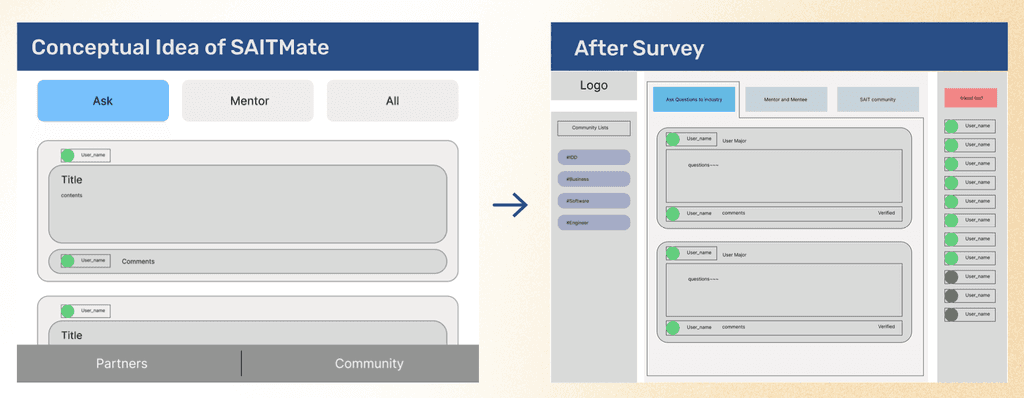
  1. Our initial idea was to have navigation bars at both the top and

    bottom, with the top bar organizing posts into ASK, Mentor, and

    All, and the bottom bar separating Partners and Community.

    However, this setup has proven confusing and n e e d s

    simplification.

  2. After the survey, we simplified the interface for better usability.

    Users found the three navigation bars confusing, so reducing the

    design's complexity will improve navigation clarity.

Second Slideshow

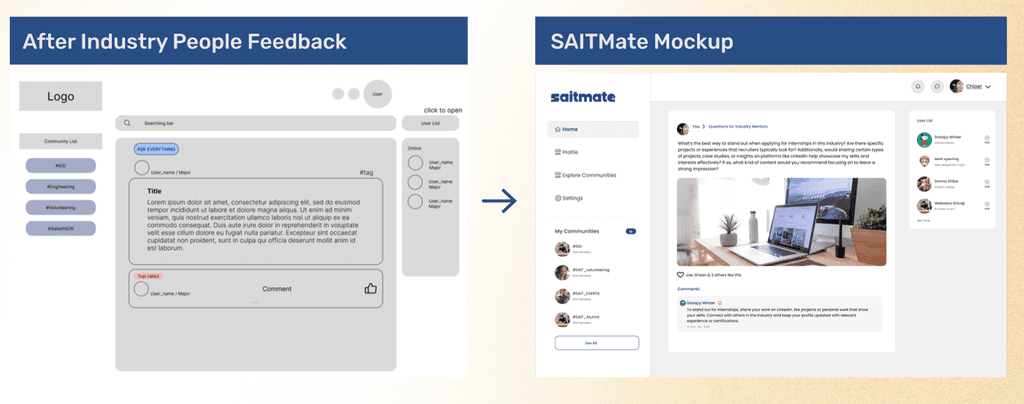
  1. After meeting with the industry mentor, we removed the top

    navigation bars and organized content by tags and topics. Posts

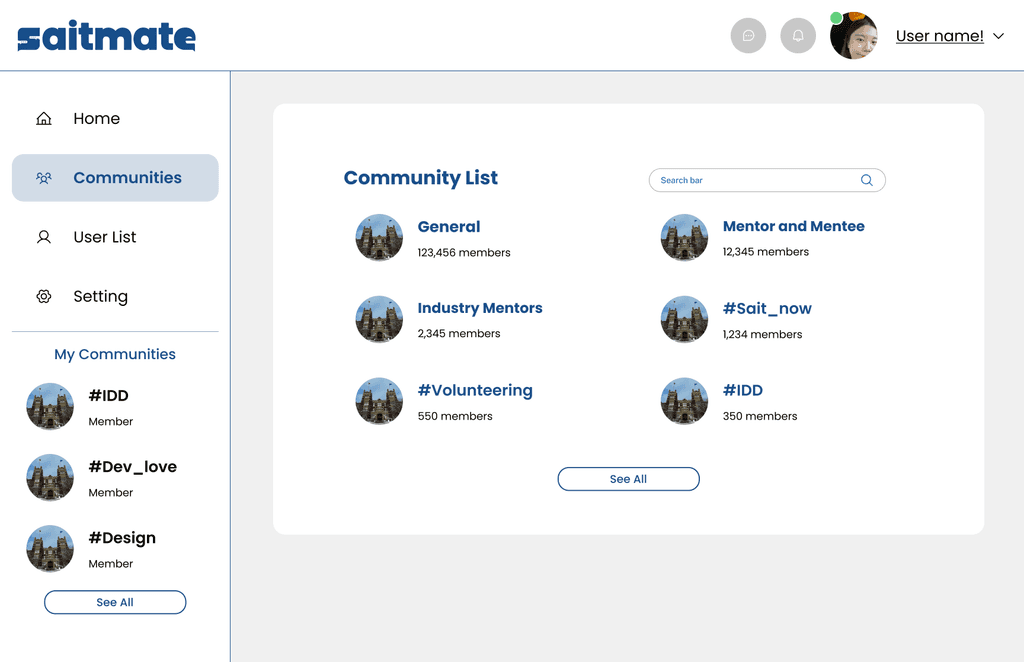
    are searchable, a community list with "favourites" is on the right,

    and the top-right includes notifications and chat. An expandable

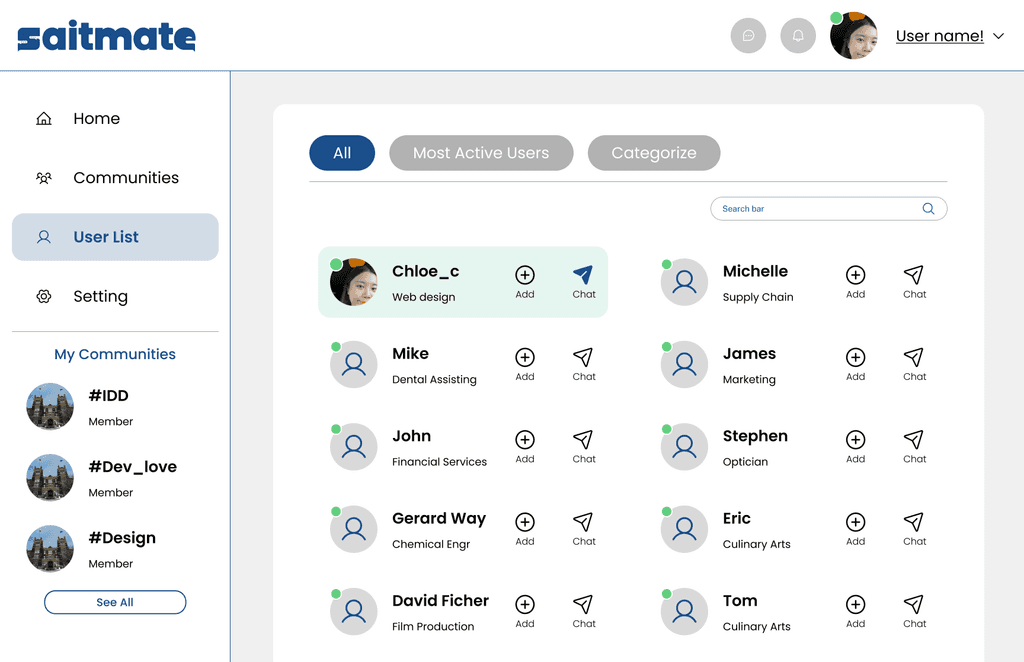
    user list shows online users ranked by activity.

  1. Final Results

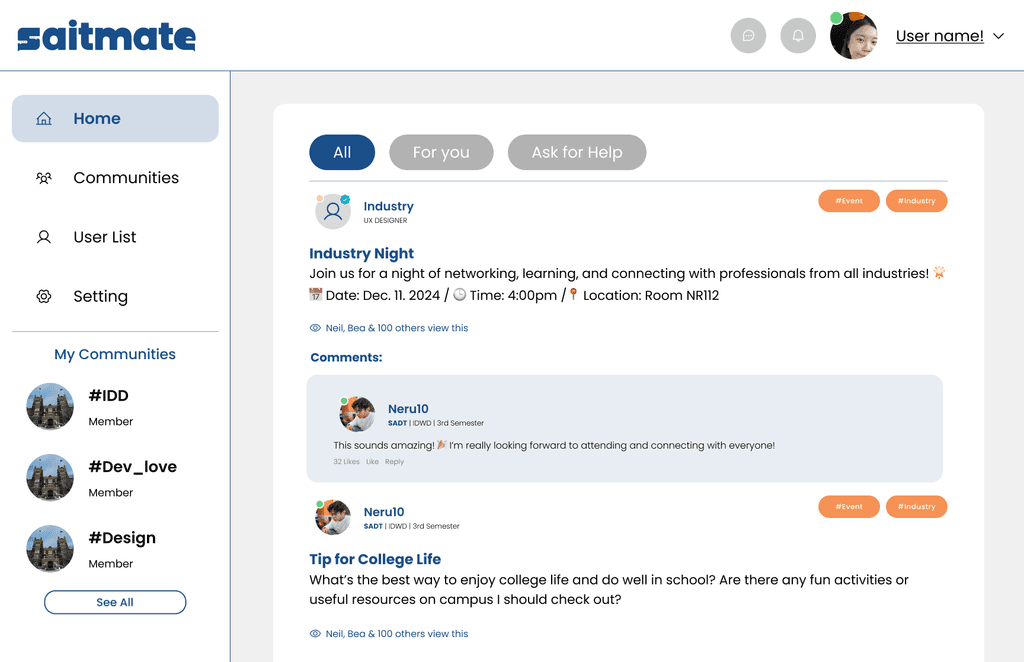
✸ Delivering the Comprehensive Solution

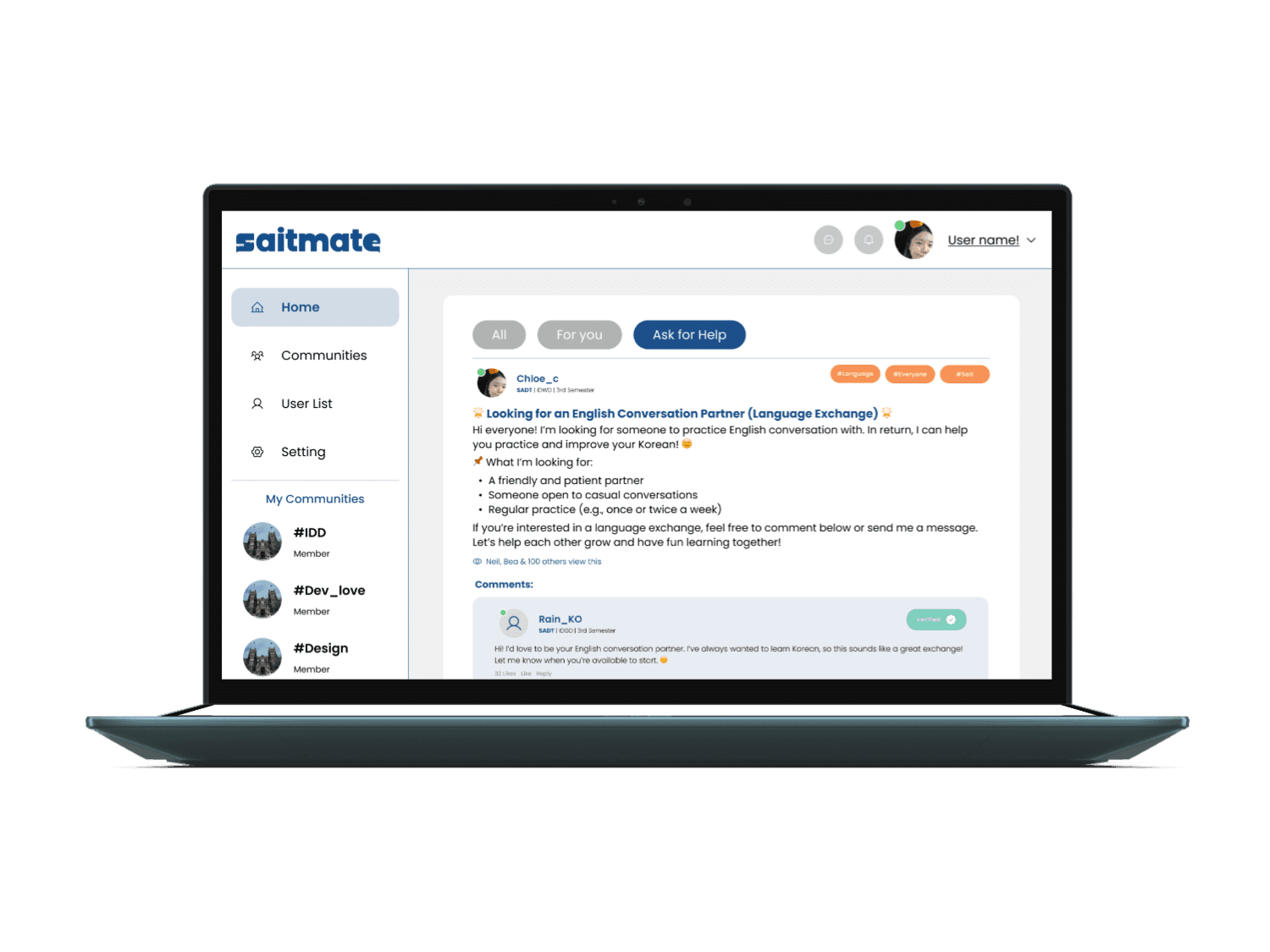
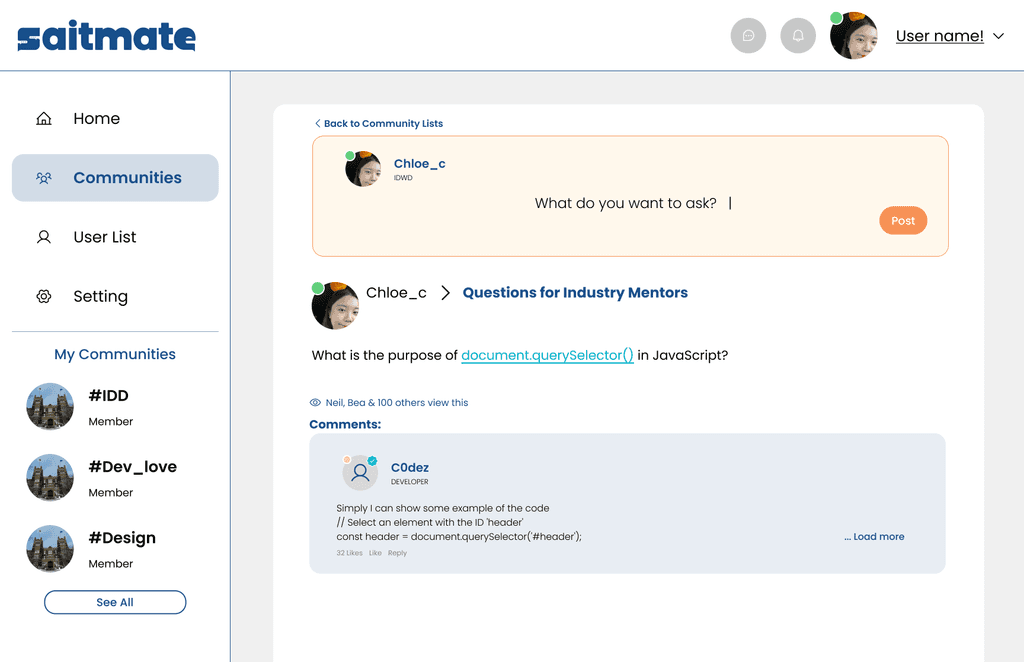
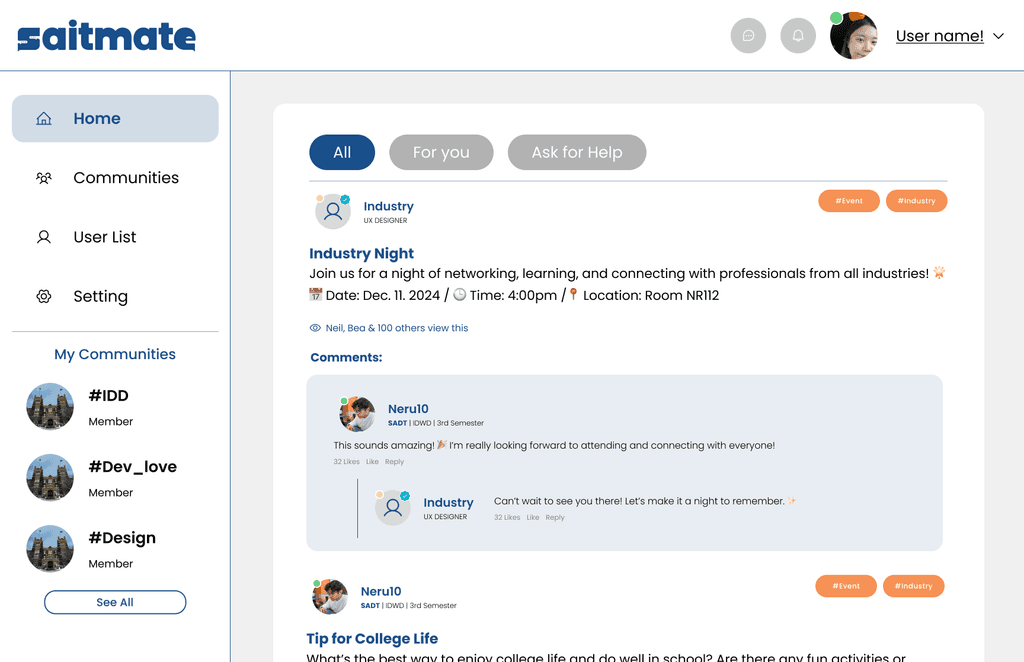
Centralized Board Wall Provides an easy-to-use interface for resources, communication, and recommendations.

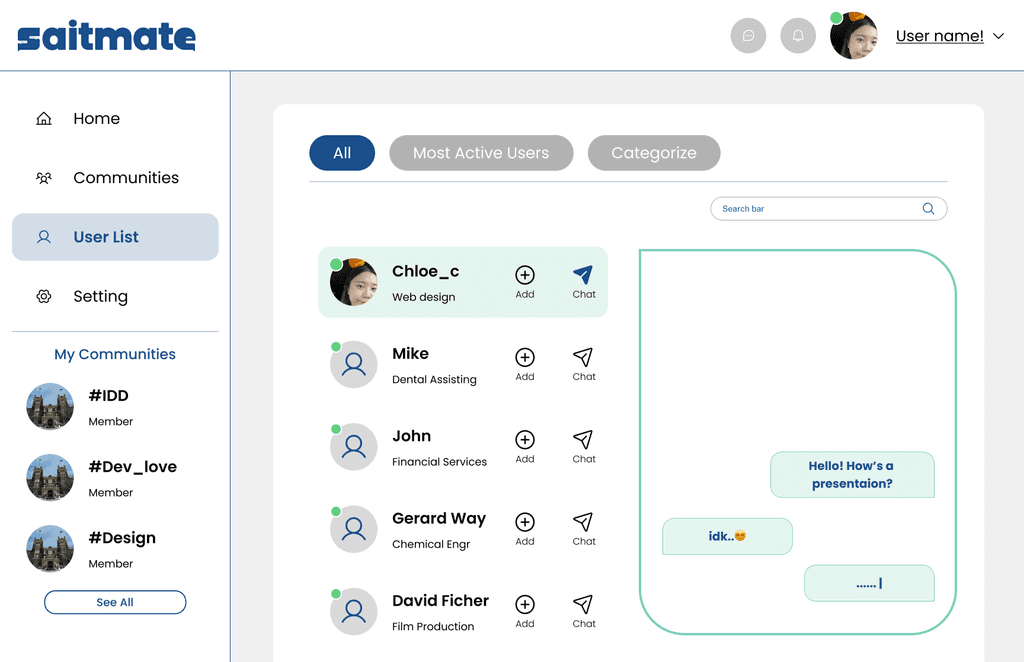
SAITMate connects students and alumni through real-time chat, mentorship matching, and an intuitive dashboard.

Post-launch, 73% of students plan to use it regularly, and 50% report better networking, proving its impact on career growth. Future updates will enhance engagement and opportunities.
© 2025 Chloe Sueun Choi